

Strength Deployment Inventory
Personality Assessment
Strength Deployment Inventory
Tim is the co-author of the SDI, which has been used by over 5 million people to increase self-awareness and interpersonal effectiveness. Elias Porter, who introduced the SDI in 1971, acknowledged before his death in 1987 that there was more work to be done on the assessment and the underlying theory. Starting in 1995, Tim led the further development of the SDI, and after several revisions to methodology and writing significant new interpretive material, his partners added him as a co-author to the assessment.


The SDI gives four views of a person.
Two are about personality, and two are about behavior.
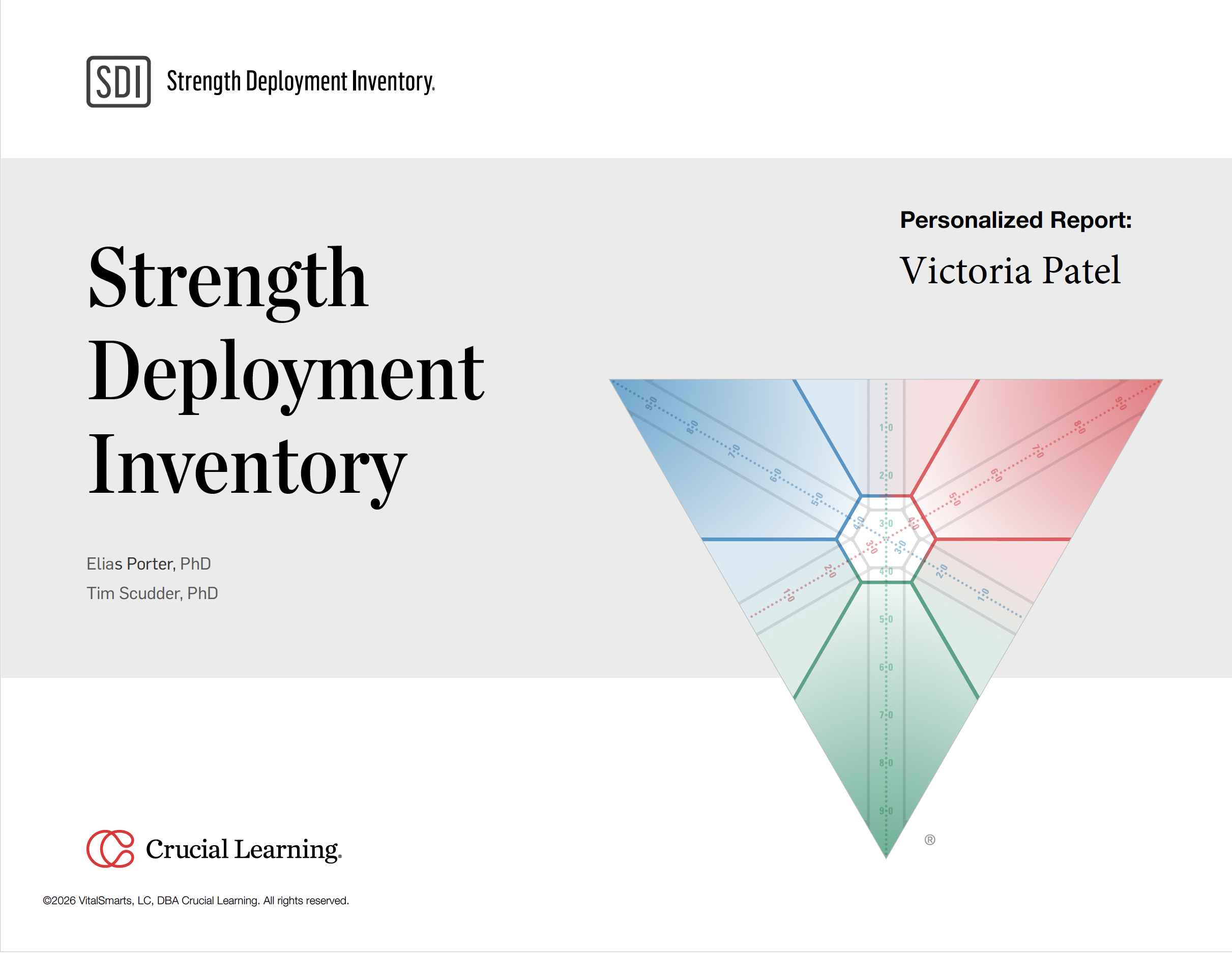
1. Motivational Value System (MVS): a view of personality when people are feeling good about themselves, based on the way three primary motives blend. The seven MVS types explain differences in the way people perceive themselves and others, and how they choose to deploy behaviors in various situations.
2. Conflict Sequence: a view of personality when people are experiencing threats to their sense of self-worth. Thirteen conflict sequence types explain the way motives change as people go through up to three stages of conflict in an effort to defend their self-worth and return to feeling good about themselves.
3. Strengths Portrait: a view of behavior focused on the context of work. A set of 28 strengths are ranked from most to least likely to deploy, which helps to explain how people chose and give meaning to their strengths, and to develop strength-based agility for greater interpersonal effectiveness.
4. Overdone Strengths Portrait: a view of behavior at work that is well-intended, but when over-used or misapplied may limit personal effectiveness or trigger conflict with others. A set of 28 strengths are ranked from most to least likely to overdo, which helps to develop strategies to minimize their negative effects and enhance overall effectiveness.
Strength Deployment Inventory and SDI are registered trademarks of Vital Smarts (dba Crucial Learning).